Oxygen Not Included review: your plumbing has consequences
A wonderful colony-management pressure cooker where the emergency is often something you built yesterday.
Zombie Games Editorial ·
Based on official documentation and gameplay imagery.
The colony has beds, a bathroom and something approximating dinner. Excellent. Now inspect where the bathroom water goes. Oxygen Not Included makes yesterday’s sensible construction project the prime suspect in tomorrow’s emergency, and that delayed chain of consequences is its wicked little genius.
Klei’s single-player colony simulation puts Duplicants inside an asteroid and hands you the excavation orders. You manage a cross-section of rooms, machines and living things. Survival means understanding what flows between them, including the unpleasant substances everyone would rather pretend are somebody else’s problem.
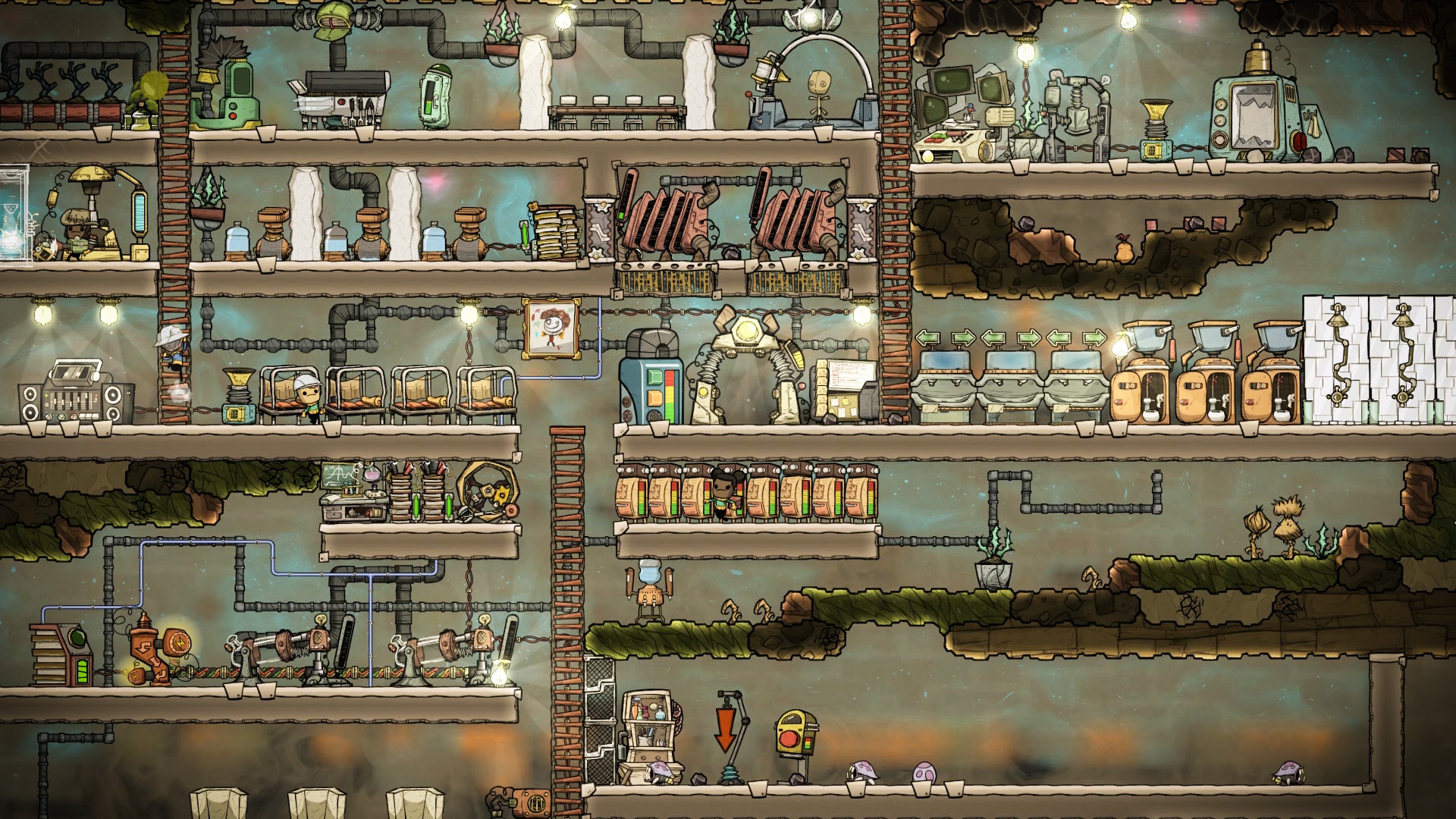
Every new mouth is an infrastructure project
Digging opens space for bedrooms, food production and machinery, but it also changes the colony’s surroundings. Removing a wall can connect previously separate gas pockets or release liquid into a work area. Expansion is therefore an engineering decision, not simply painting more floor onto the map.
More Duplicants mean more hands to build and carry supplies. They also mean more demand for food, breathable air and usable facilities. The important question is whether your production can support another worker consistently, not whether an extra pair of arms would make today’s construction faster.
That tension keeps the small tasks meaningful. A longer ladder route wastes time; an inconvenient supply location adds hauling; a machine without its required input contributes nothing. The colony’s productivity lives in the relationships between buildings, rather than in a tidy count of how many you own.
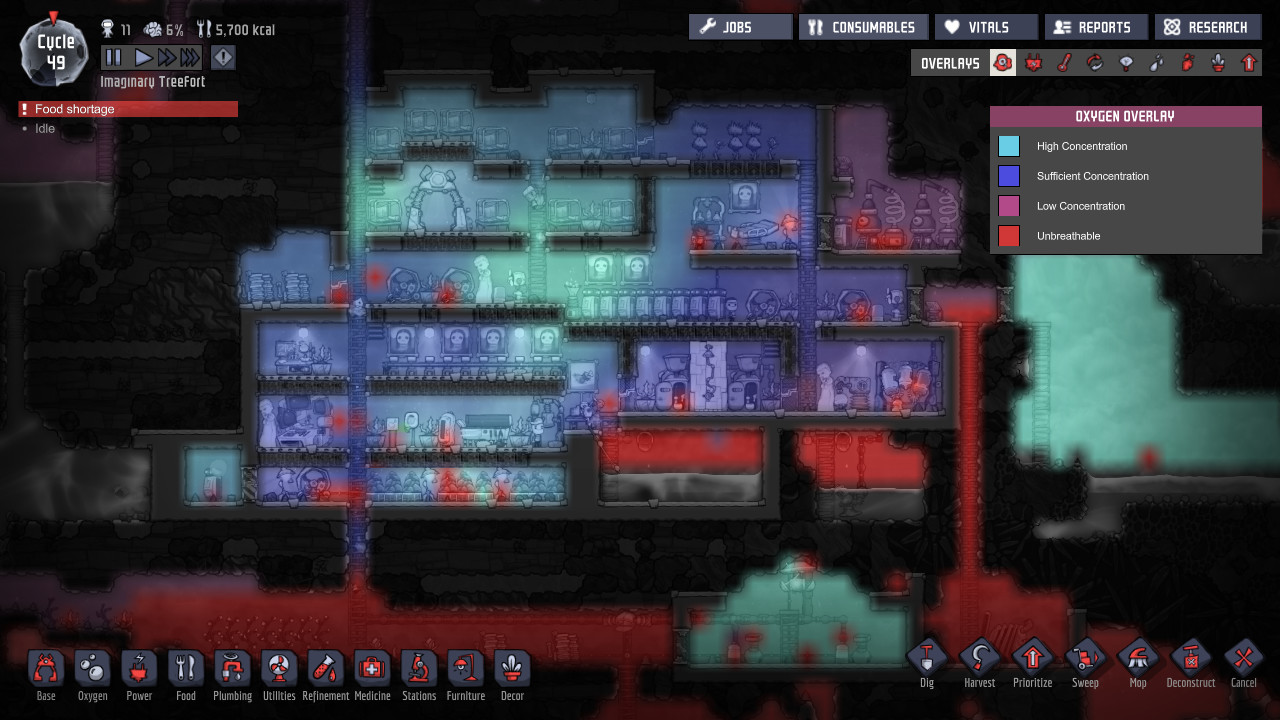
Air does not respect your floor plan
The oxygen overlay turns an attractive ant farm into a diagnostic map. Breathable areas and dangerous pockets become visible, so you can judge where oxygen is reaching and where carbon dioxide is accumulating. A reassuring total elsewhere in the base does little for a worker in the wrong room.
Gas management makes exploration consequential. A tempting pocket of resources might sit beyond an atmosphere your crew cannot comfortably work in. Suits and supporting infrastructure extend your reach, but reaching the resource is only half the job; you must also make that journey practical enough to repeat.
The best design decisions solve more than the immediate symptom. Opening a route can help circulation and shorten travel, yet expose rooms to conditions you had kept outside. That is the attraction here: a wall is simultaneously architecture, a boundary and a promise you might later regret.
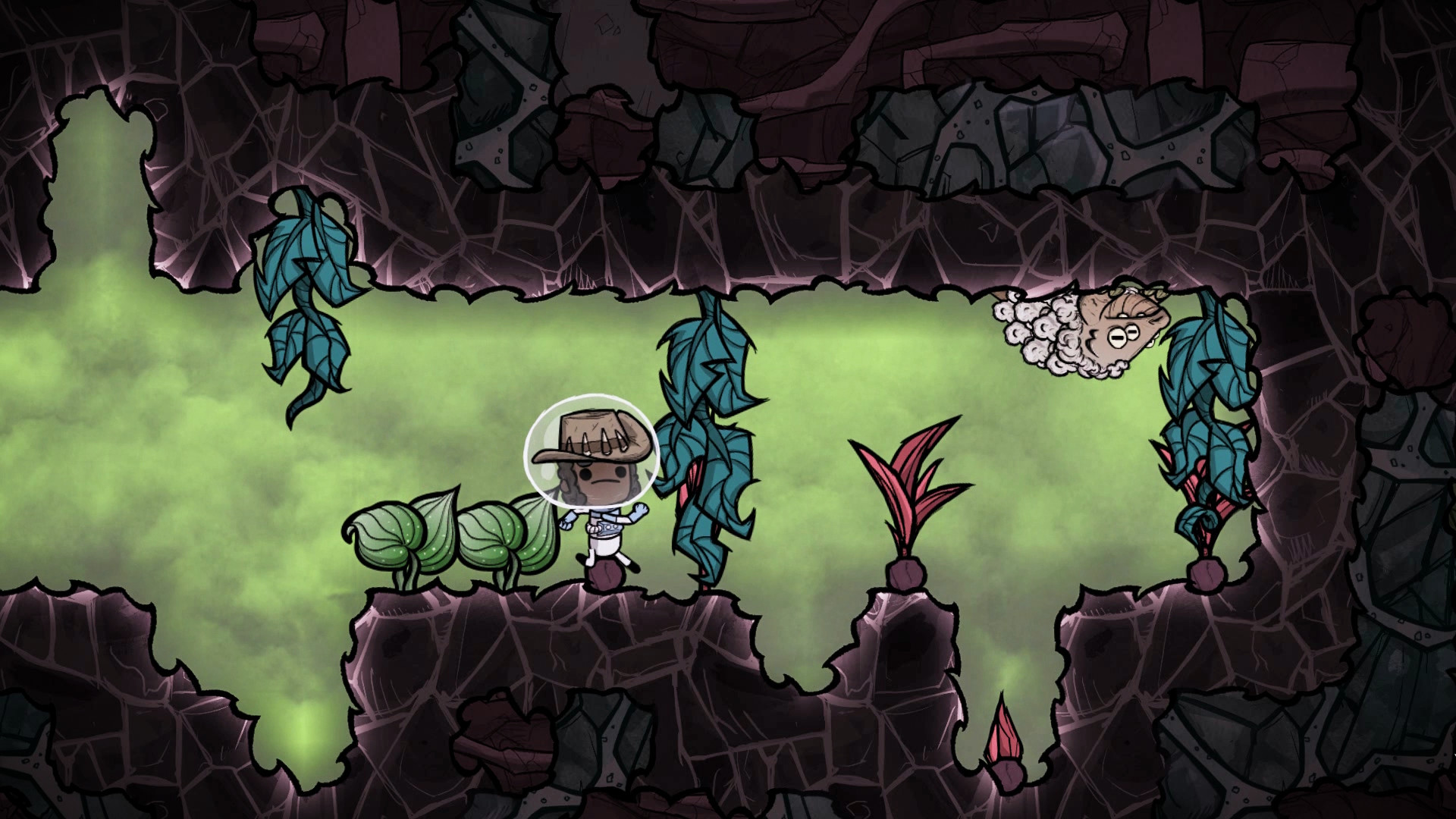
Yesterday’s plumbing would like a word
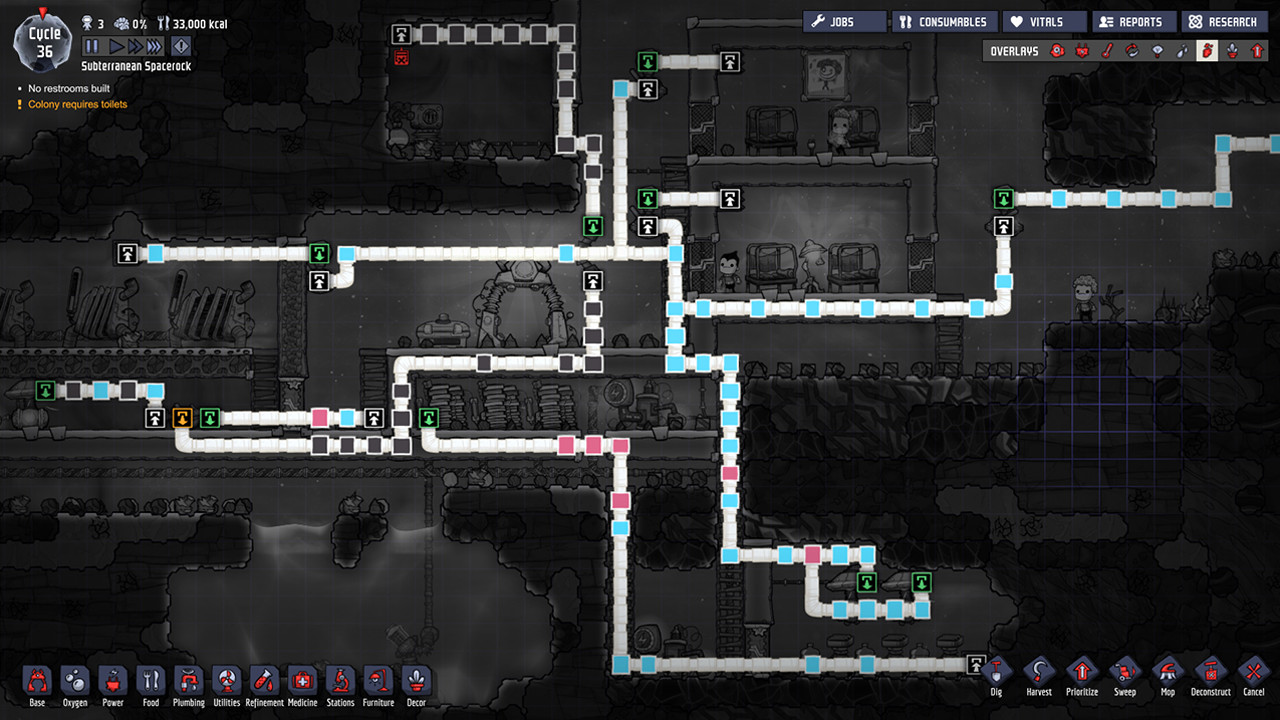
Pipes give liquids and gases specific routes through the colony. Pumps, filters, building inputs and outputs have to form a working chain. A visually impressive installation can still accomplish nothing if its destination is blocked, its supply is missing or its power circuit cannot support it.
This changes how upgrades feel. A plumbed facility trades manual errands for dependence on a network. That is often a good bargain, until the network fails and several apparently unrelated buildings stop together. The fix starts upstream, not necessarily at the machine displaying the angriest icon.
Power introduces the same discipline. Extra generation is not a substitute for checking circuit capacity and demand. Automation lets signals govern equipment, reducing the need to babysit every switch. Building a system that stops itself appropriately is often more impressive than building one that runs continuously.
Research unlocks possibilities, not solutions
Research expands your construction options, but an unlocked machine still needs materials, labor and a functioning place in the base. The meaningful progression is learning when to use a tool. Racing down the technology tree cannot compensate for a colony that cannot reliably feed its existing equipment.
Heat makes that distinction especially sharp. Industrial equipment changes local temperatures, and temperature affects the conditions plants and Duplicants need. Keeping production close to everything it serves can shorten logistics while creating a thermal problem. Insulation and sensible placement matter because the consequences keep spreading after construction finishes.
Klei’s March 2026 update adjusted temperature exchange and fixed several simulation issues; June brought further changes shared by all versions. Those are released base-game improvements. They do not remove the central challenge: you are designing a working environment, with several interdependent systems competing for the same space.
Your workforce would appreciate a break
Duplicant skills add another balancing act. Training opens useful capabilities, but learned skills accumulate morale expectations. A broad generalist is therefore not automatically the best worker to create. Specialization gives you a reason to improve living conditions rather than treating the crew as interchangeable construction tools.
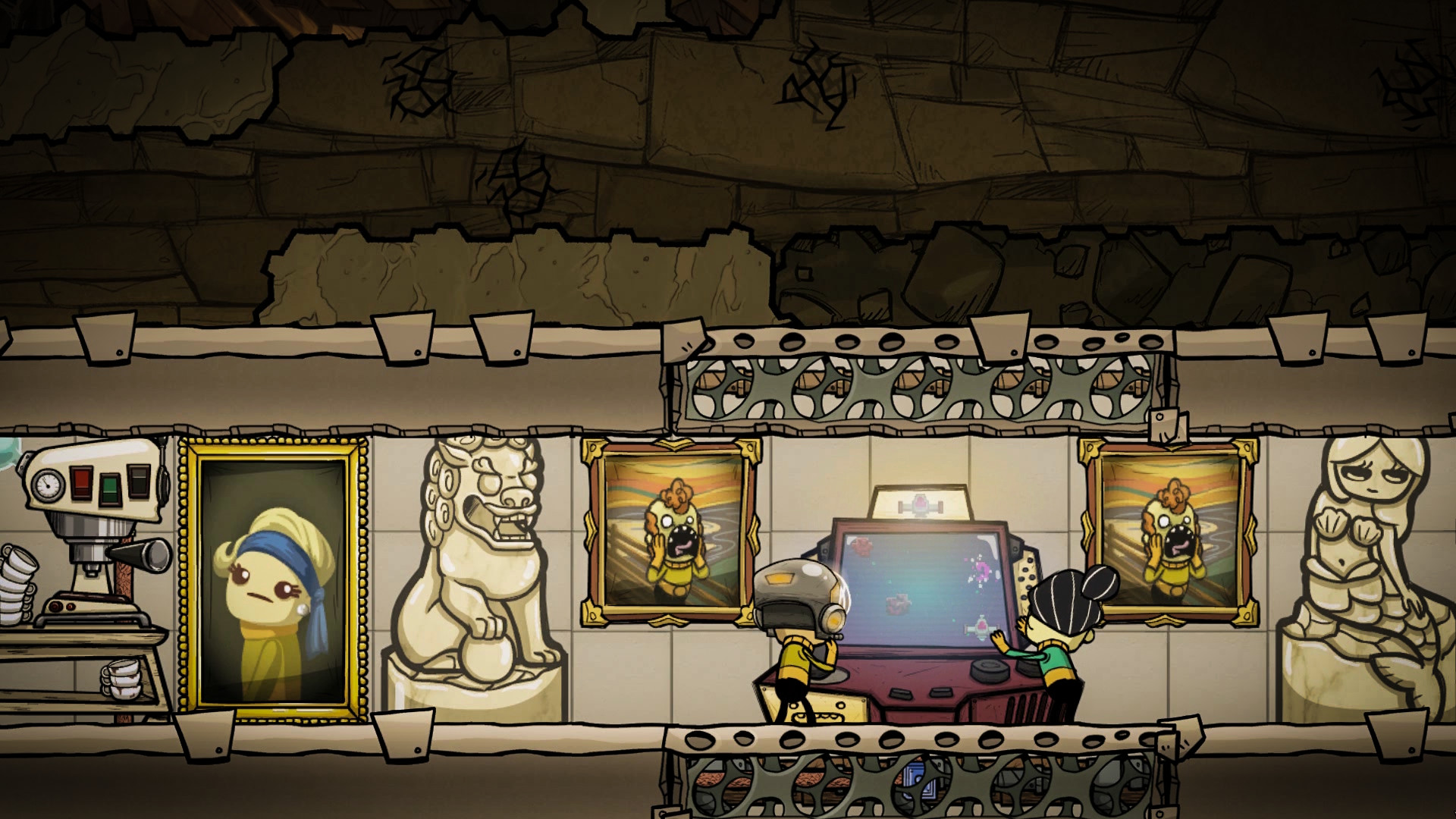
Food, accommodations and recreation make comfort part of the machinery. Stress responses can disrupt the colony, while sufficiently high morale can produce beneficial overjoyed reactions. The little characters give these systems personality: a recreational room is infrastructure with an arcade machine in it. Accounting has rarely looked this cheerful.
The interface supplies overlays, status information and an in-game database, yet finding the relevant explanation remains work. Reading a warning is easier than tracing every cause behind it. This is the main usability reservation: the game offers extensive control, but asks you to develop the diagnostic habits that make it useful.
The base game already reaches for space
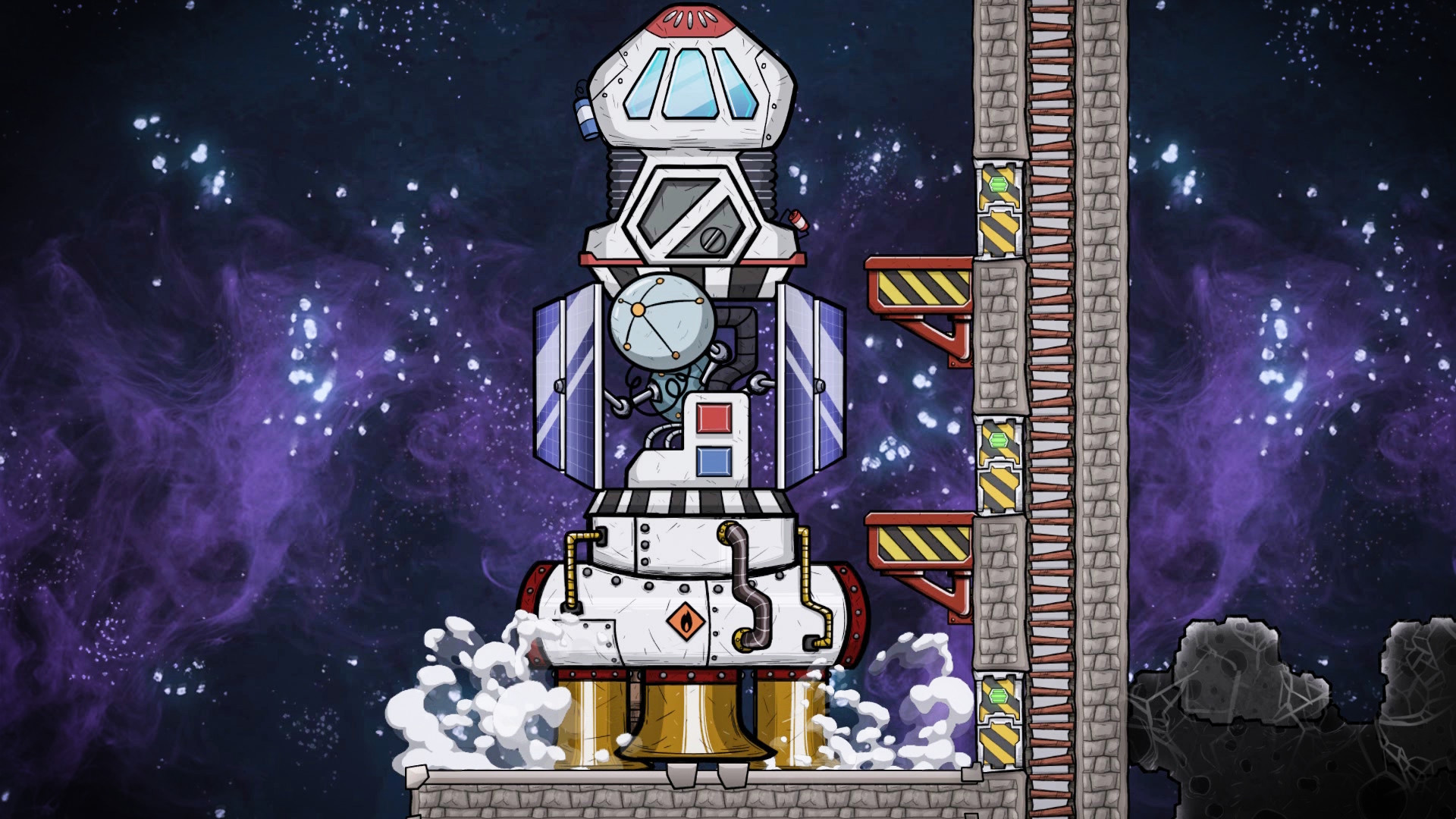
Base-game rocketry provides a distant purpose for the industries below ground. Space research, rocket components and rare materials extend the engineering ladder beyond basic survival. Getting there is satisfying precisely because a launch represents many earlier problems solved well enough that the colony can afford a larger one.
Spaced Out! is a separate paid expansion with simultaneous colonies across multiple planetoids, expanded rocketry and radiation systems. The Frosty Planet, Bionic Booster, Prehistoric Planet and Aquatic Planet packs are also paid additions. Their new environments or specialized systems should not be mistaken for requirements to enjoy the base game.
Aquatic Planet launched on June 11, 2026, with swimming and a marine starting world; it is already available, not an upcoming promise. The base game received accompanying free changes, including improved liquid visuals. Buy expansions for the specific new problems you want to solve, rather than assuming more complexity is mandatory.
Strengths
- Interlocking gas, liquid, heat and power systems make practical understanding rewarding.
- Skills and morale connect worker development to the quality of colony life.
- Base-game research and rocketry provide substantial goals without requiring paid expansions.
Tradeoffs
- Diagnosing a failed production chain demands close reading and experimentation.
- Small infrastructure mistakes can spread into several simultaneous shortages.
Who it suits
- Best for patient builders who enjoy tracing causes and redesigning systems.
- A strong choice for solo survival through planning, with incidental creature threats rather than a combat-centered campaign.
Verdict
Oxygen Not Included is exceptional at turning practical understanding into progress. A dependable utility network feels more valuable than another unlocked building because it gives the colony room to attempt something ambitious. Its greatest reward is recognizing a failure before the alarm starts shouting.
The price of that depth is substantial mental overhead. Expect investigation, rebuilding and experiments that expose a second problem underneath the first. For players who enjoy asking why a system failed, this is a wonderfully absorbing base game. Anyone seeking straightforward combat or effortless decoration should look elsewhere.
PC base game
Review score: 8.2 / 10
- Combat
- —
- Progression
- 9.4 / 10
- Usability
- 6.4 / 10
- Value
- 8.7 / 10
Covers the Windows, macOS and Linux base game with released free updates.
Spaced Out! and the Frosty Planet, Bionic Booster, Prehistoric Planet and Aquatic Planet packs are separate paid DLC, excluded from this rating.
The review score averages the applicable Combat, Progression, Usability and Value scores, rounded once to one decimal. Fit is specific to each comparison and is excluded.
Is Oxygen Not Included multiplayer?
No. The official game is single-player, and Klei says it was designed around that experience. Managing several colonies in Spaced Out! still means one player overseeing those colonies; it does not turn the game into co-op.
Do I need Spaced Out! to launch rockets?
No. The base game already includes rocketry and space research. Spaced Out! changes and expands the space systems, adding multiple colonies and interplanetary resource logistics, so it is a different management challenge rather than a prerequisite for reaching space.
Should a beginner buy all the DLC?
The base game is the sensible starting point if its engineering systems are new to you. It has substantial survival and research goals already. Add a pack when its particular setting or mechanics appeal, after checking that pack’s description.
Why can a functioning colony suddenly develop shortages?
Its systems share dependencies. A lost input, blocked output, overloaded circuit or unsuitable temperature can interrupt production elsewhere. Check the affected building’s status, then follow its supply and output connections instead of assuming another copy of the building will solve the problem.
Does the base game include swimming now?
Swimming belongs to the paid Aquatic Planet Pack, released in June 2026. The accompanying free update also changed the base game, including liquid visuals and suffocation rescue behavior. Those shared improvements do not grant the DLC’s marine world or swimming system.
Sources
- Klei: game overview and official media ·
- Steam: PC base game, platforms and features ·
- Klei: March 2026 simulation and interface update ·
- Klei: June 2026 free update and Aquatic Planet release ·
- Klei: July 2026 hotfix 744825 ·
- Klei: skills, morale and conveyor-system changes ·
- Klei: free recreation update and overjoyed responses ·
- Klei: base-game space research and rocketry ·
- Steam: Spaced Out! expansion ·
- Klei support: single-player design ·
- Steam: The Aquatic Planet Pack ·