Zombie shelter & base management
Manage an underground zombie shelter, upgrade production rooms, assign specialist residents, grow food and choose lasting research paths between active survival runs.
- 5
- core production rooms
- 4
- research branches
- 18h
- maximum offline production window



A safe room is only the beginning. In Zombie Defence, the underground shelter turns every recovered supply into a decision: feed the next deployment, expand a production line, fill the research store or invest in the people who make this place feel lived in.
Build an underground shelter around useful rooms
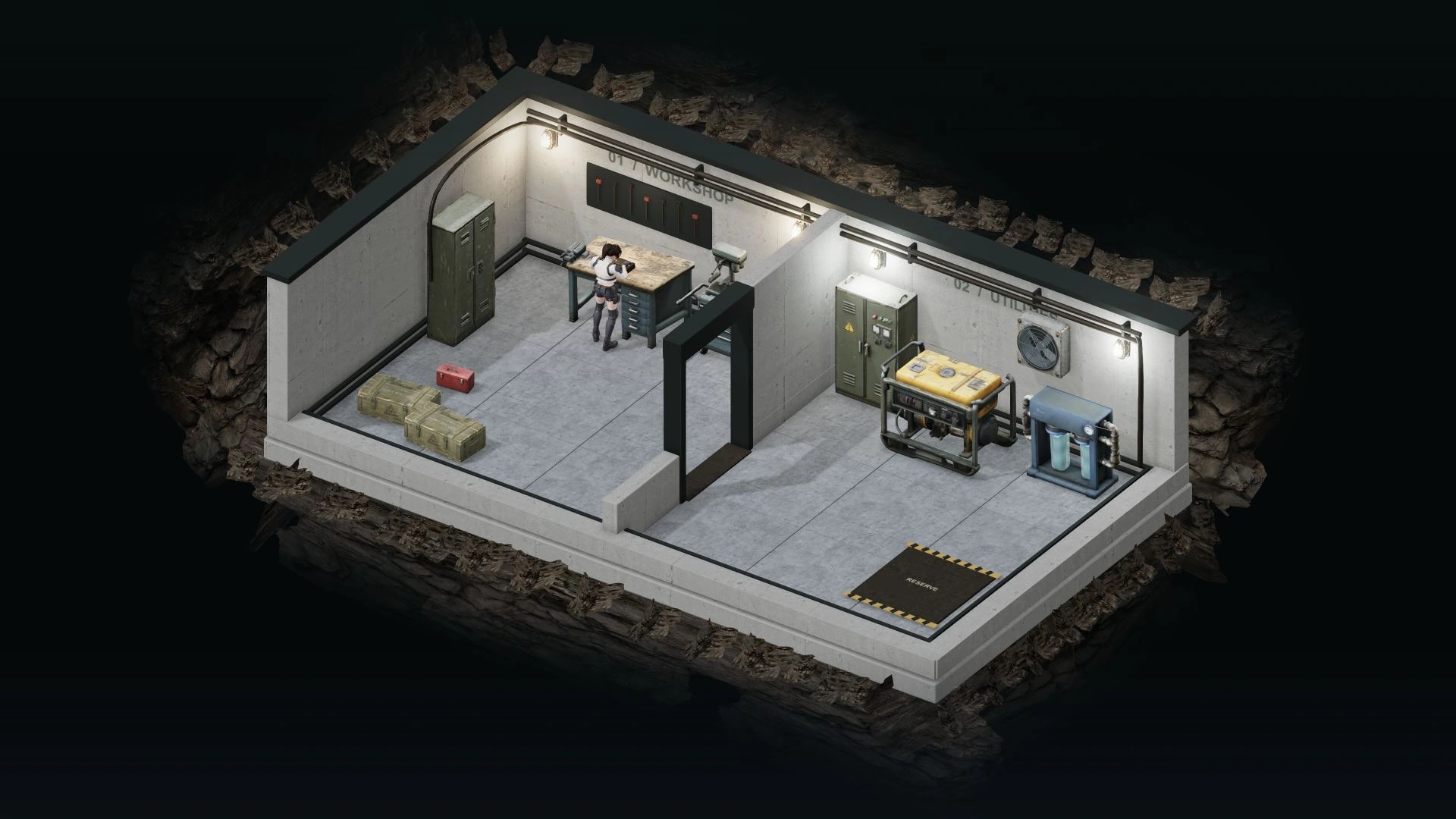
Base building here means developing a compact underground refuge, improving the rooms that keep the next run possible. The Water & Hydroponics room produces food and supports crop irrigation; the Generator supplies energy; the Research Lab generates research; the Ammo Press turns battlefield scrap into ammunition; and the Salvage Bench converts scrap into parts or ammunition. Each room can be upgraded, and an expansion bay can add a second generator, garden or salvage station.
Those systems compete for the same recovered materials. Scrap spent improving a room cannot also become ammunition or machine parts, while energy and food are needed to prepare another deployment. Storage has a ceiling too, so a production room that fills its store stops contributing until there is room again. Shelter management is a balancing act between immediate readiness and a stronger long-term base.
- Upgrade one of five core rooms to raise its output.
- Use the expansion bay for more energy, irrigation or scrap processing.
- Watch storage limits and the material costs shared by construction and crafting.
Assign residents where their work matters
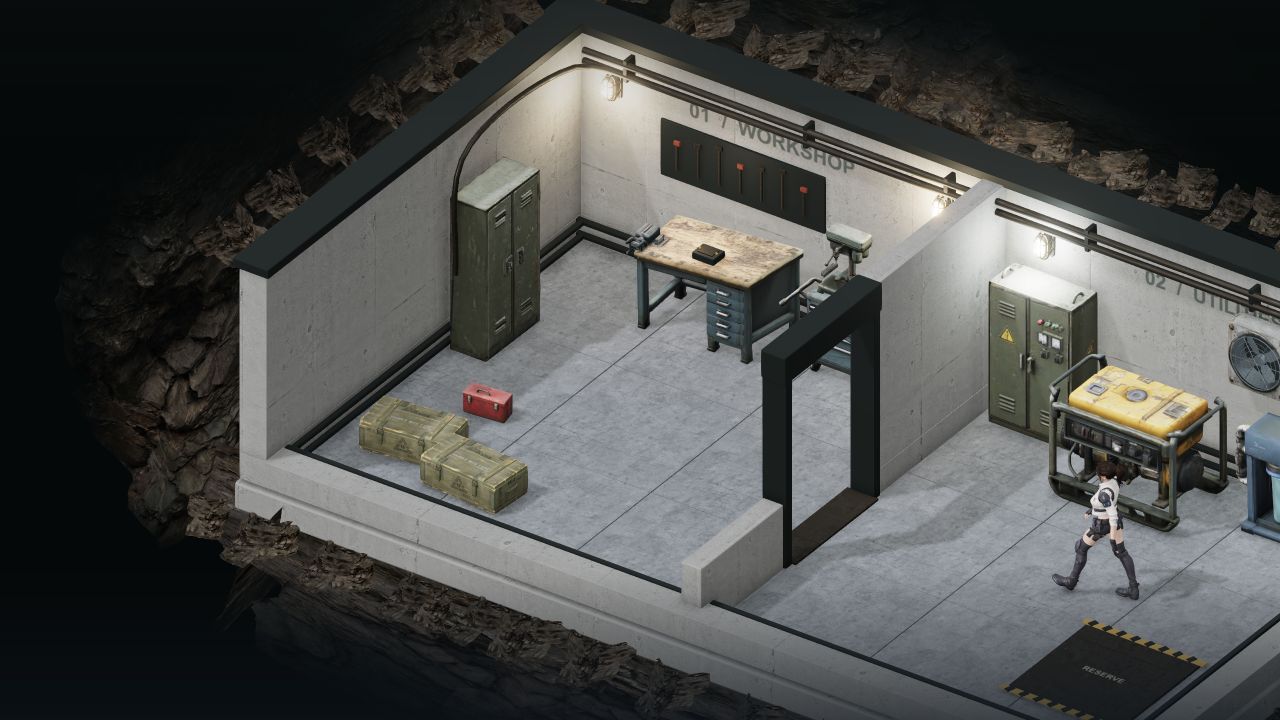
Residents are part of the production plan, not just faces in the shelter. Assign one resident to a room to increase its output; a person’s specialty adds another boost when they work at the matching station. Each resident can hold one work assignment at a time, so moving a specialist to the Lab means giving up that person’s help at the Generator, garden, Salvage Bench or Ammo Press.
The campaign data defines five women for the resident roster: Mara the mechanic, Iris the botanist, Sable the quartermaster, Jun the electrical engineer and Vera the radio researcher. Their specialties map to different shelter stations. The current demo gate makes Mara playable; the other four are not available in the demo. Residents can train and build relationships through conversations as campaign access allows.
- Put a resident in a room to raise its production rate.
- Match a specialist to their station for an additional bonus.
- Reassign workers as your immediate resource bottleneck changes.
Keep food production connected to the growing room
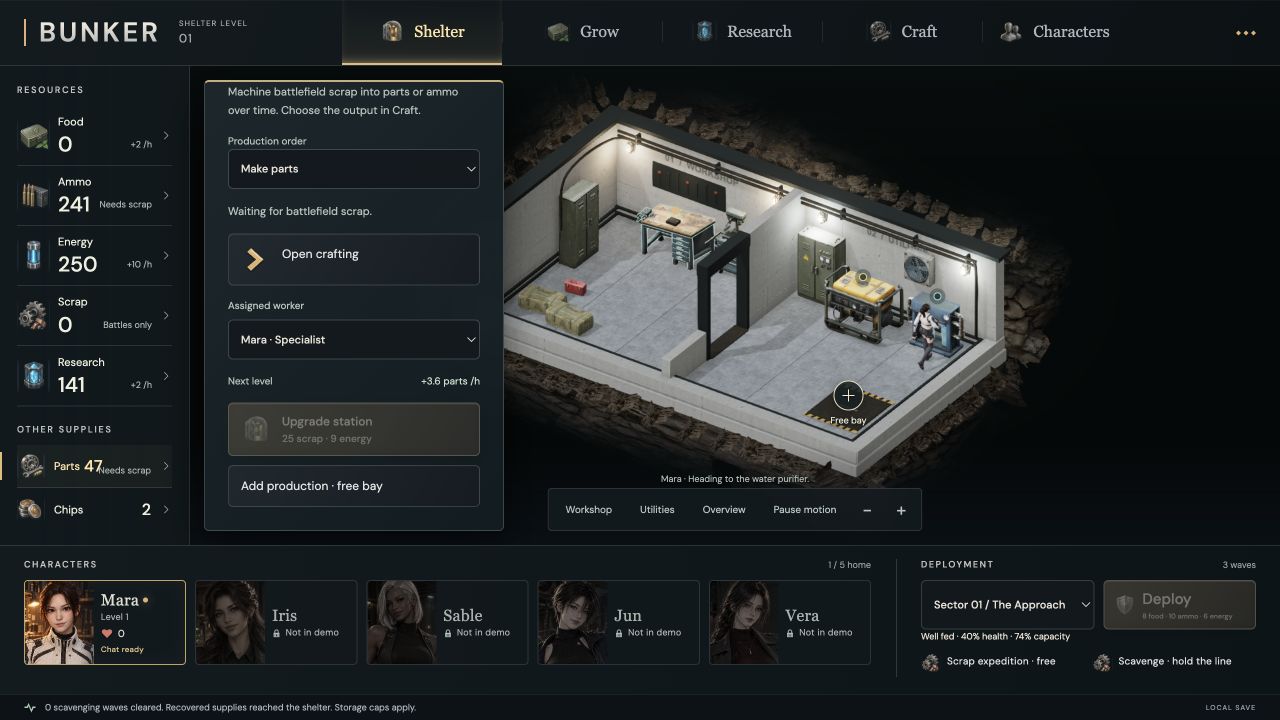
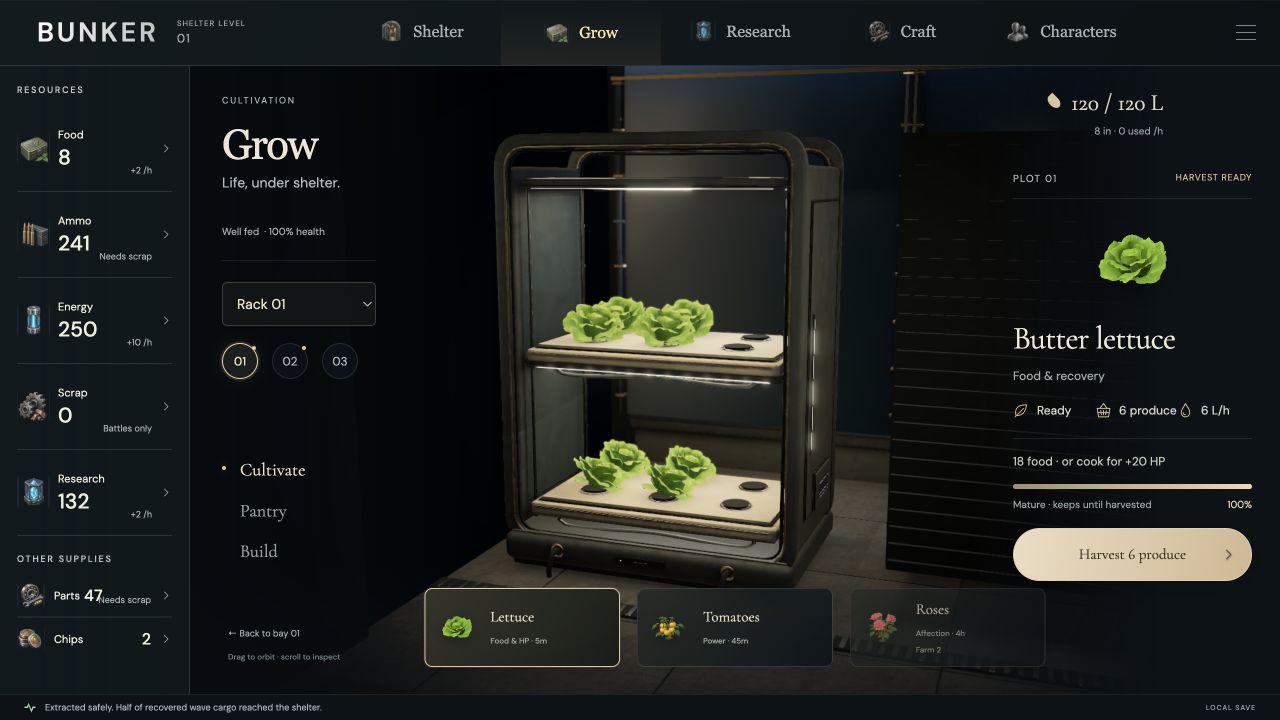
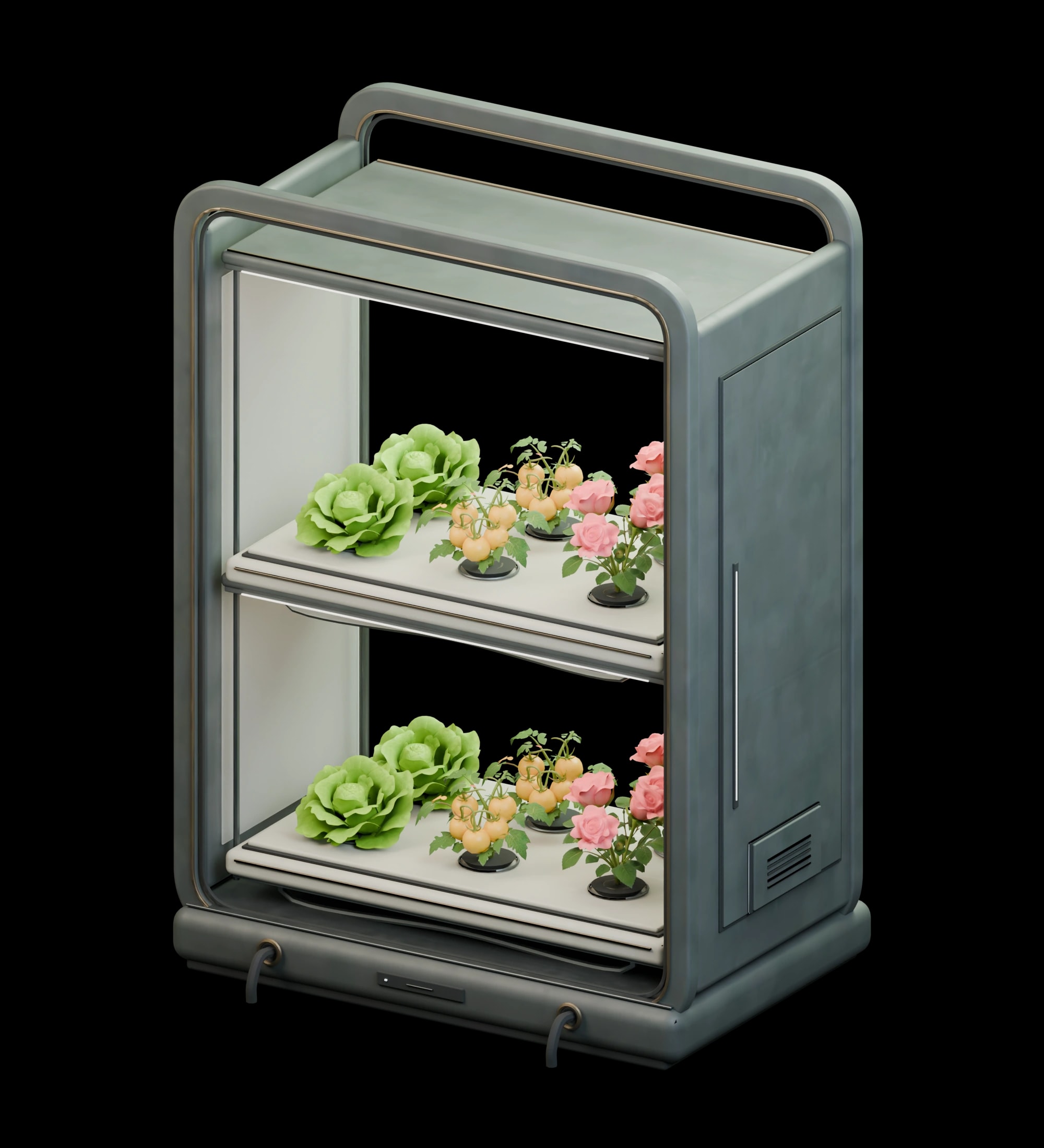
Food production links the base economy to a hands-on hydroponics system. Crops grow on a timer, with progress shaped by available irrigation and stored water. Lettuce, tomatoes and roses serve different needs: harvests can refill food stores, support recovery or provide a small relationship gift. Tending an unfinished crop costs stored water and improves its harvest. More farm racks add plots, while purifiers raise irrigation supply.
Growing remains a resource choice. Hydroponics needs enough irrigation to maintain full crop speed, and a growing colony consumes food over time. A full pantry or low water supply can interrupt the plan. This gives the underground base its own rhythm between deployments: check the plots, decide what to plant next, and make sure the food line can support both residents and the next trip outside.
Choose a research direction with lasting effects
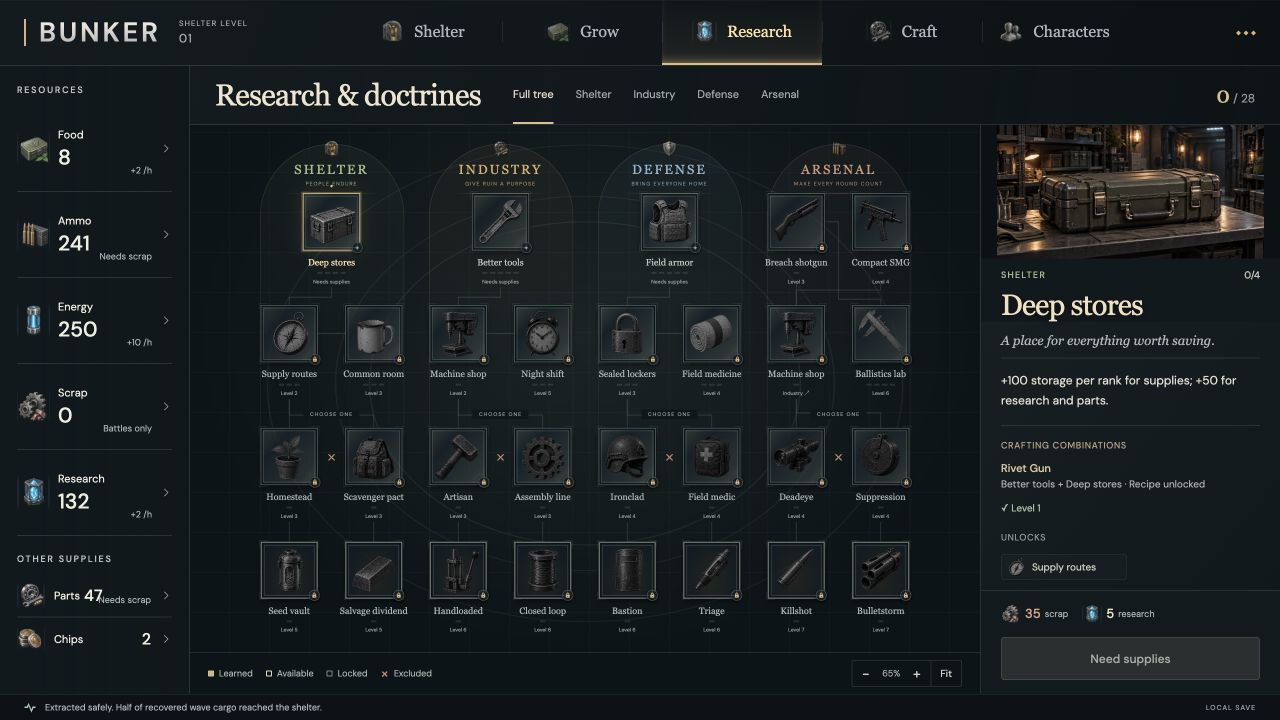
Research from the Lab opens a branching technology tree across Shelter, Industry, Defense and Arsenal. Early investments can expand storage, increase passive production or improve battle health. Prerequisites then lead toward more focused plans: strengthen supply logistics, unlock a machine shop and crafting options, reduce losses after defeat, or shape weapon performance for a preferred combat style.
Some later doctrines are mutually exclusive pairs. For example, a shelter can prioritize stronger food and energy production or better expedition salvage returns; the Industry branch can favor cheaper crafting or faster scrap processing; and Arsenal choices trade firepower against speed, range or magazine size. The decision is permanent in the save, so research is a build path rather than a checklist to complete in every direction.
- Shelter technology improves capacity and expedition logistics.
- Industry research changes passive production and workshop crafting.
- Defense and Arsenal upgrades alter survival and weapon behavior in combat.
Turn each run into persistent survival progression
Deployments supply the resources that keep the shelter moving. Sector victories, salvage expeditions and scavenging runs settle different rewards, but they all feed the decision about what to improve next. A defeat can levy a bounded amount from exposed supplies and set back sector progress; the base, its residents and permanent upgrades remain. That persistence gives survival runs a longer arc than the result screen alone.
Production accrues with elapsed time, including while away, but only through a capped window: eight base hours, plus two hours per Night Shift rank and four hours from Seed Vault, for an 18-hour maximum. Storage, available scrap and active production orders still constrain the result: presses stop when their input runs out or their output store is full. The shelter rewards planning between sessions while leaving scavenging and zombie combat as active play.
Three choices shape the next deployment
The best shelter plan depends on the resource you keep running short of and the kind of run you want to support.
Build capacity or increase output
Invest in storage when valuable supplies keep hitting their cap; improve a room or industry research when the shelter needs resources faster. A faster line has little value if it is already sitting at full storage.
Assign the specialist or cover a weak room
Match a resident’s specialty to maximize one station, or place a worker where a critical resource is falling behind. Since a resident only works one room at once, every assignment leaves another station without that boost.
Commit to a doctrine that fits your runs
Choose production and logistics support for a resource-hungry base, or invest toward combat-focused Defense and Arsenal routes. Mutually exclusive research pairs mean the choice changes your campaign instead of granting every bonus eventually.
Before you head out.
Questions about Shelter in the current Alpha.
Yes, with a defined underground base rather than unrestricted construction. You upgrade production rooms, use an expansion bay, assign residents, grow crops, craft supplies and research permanent shelter technologies between active zombie runs.
No. The current campaign develops fixed shelter rooms and stations. It does not offer freeform wall placement or a tower-defense grid where zombies attack the base.
The core rooms support food, ammunition, energy, research and parts. Salvage and ammunition production consume scrap, while food also connects to hydroponic crops, water and resident upkeep.
Yes. Assigning a resident to a room raises its output, and a matching specialty gives a further bonus. Each resident can be assigned to one room at a time.
Production uses elapsed time and supports capped offline accrual: eight base hours, up to six more from Night Shift and four from Seed Vault. Storage limits and production inputs such as scrap still constrain what the shelter can make.
You can invest across four branches, but several advanced doctrine pairs exclude one another. Their prerequisites and permanent effects make a focused research plan useful.
Permanent rooms, research, residents and shelter progress remain. A sector defeat can take a bounded levy from supplies above a protected floor and move the next sector back, while supply runs use their own settlement rules.
No. Production can accrue between visits, but obtaining fresh supplies still means playing deployments, salvage expeditions or scavenging runs, and crop harvesting and shelter decisions remain part of the loop.
Connected systems
Follow the supplies, the people and the next decision.

Crafting
Recover weapon schematics, machine the right parts and assemble a persistent arsenal in a zombie survival game where scrap, energy and research all have competing jobs.
Growing
Plant lettuce, tomatoes, or roses in an underground hydroponic shelter. Manage water, harvest crops, stock the pantry, and prepare food for zombie expeditions.





Relationships
Meet five survivors, share branching conversations, and build friendship or romance through quiet moments between Zombie Defence expeditions.
More on this kind of game
A place on the list. A way back home.
Get Alpha news and playtest updates.